Alfriston
Of all the many Downland villages, Alfriston must be one of the favourites. A remote place, bypassed by modern development, it carries the old fashioned charm we love. Tourists flock here for a taste of old England.
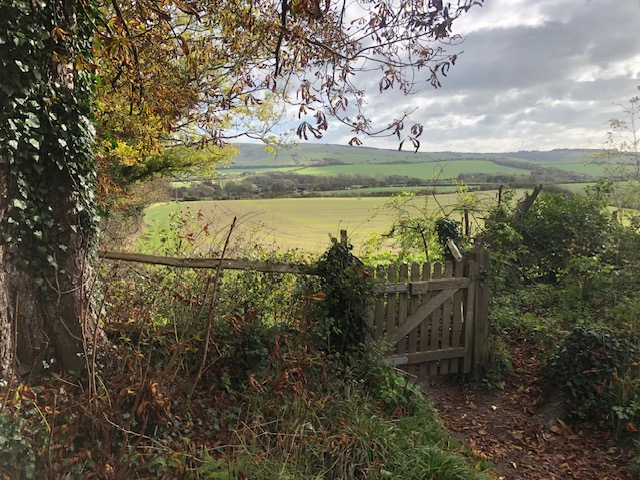
The village sits beside the small Cuckmere river, nestled in the escarpment of the surrounding downs. This Saxon settlement is set in a remote situation between Firle Beacon and the Severn Sisters. In early summer the wide open, deserted hillsides offer grand views, always with the skylarks’ jubilant outflow of song overhead.

The Alfristan Clergy house is a fine example of a typical medieval Sussex barn. For a time it was used as a vicarage. It was the first property bought by the National Trust in 1876 in a derelict state for £10.
The village has a 14th century church, a number of timber framed houses and 3 pubs including the original smugglers’ inn. There are several quirky little tea shops and a quaint little book shop called Much Ado Books, voted by the Times newspaper as on of the 6 best bookshops in the country.
The South Downs Way passes through the village. An ideal place to stop and enjoy some rest and refreshment before going on.
Before walking these downs for pleasure became popular, in 1915, the poet Eleanor Farjeon walked the 50 miles from Chichester to Alfriston. Her poem ‘All the way to Alfriston’ describes the walk. It was while in Alfriston that she wrote her popular hymn ‘Morning Has Broken’.

The large St Andrew’s Church is often called The Cathedral of the Downs.
The American author, Bill Bryson, chose St Andrew’s Church as one of his favourite churches in a top 14 list.
“It is impossible to overstate the importance of churches to this country. Nothing else in the built environment has the emotional and spiritual resonance, the architectural distinction, the ancient, reassuring solidity of a parish church…..to me, they are the physical embodiment of all that is best and most enduring in Britain.
If you are in the village on June 16th, in some years there may be celebrations for Sussex Day on the village green surrounding the Church. Sussex Day is held in a number of villages on the feast day of St Richard of Chichester (1197-1253) the patron saint of Sussex. He was Bishop of Chichester in the time of Henry III. His Prayer of St Richard of Chichester is well known.

Erik Ravilious
Before he became a war artist Eric Ravilious loved this the quiet, peaceful, English landscape and so beautifully captured it in his watercolours and etchings.
Using a ‘dry brush’ technique his brush work allows the white of the paper to shine through, marking chalky paths climbing up the rounded hillsides and flint-strewn fields.
Brought up in Eastboune, where he first studied art, he always had a special love for these chalk Downs. He loved their rusting machinery, old shepherds’ huts, tide-swept beaches, deserted hillsides and his famous depictions of hillside chalk figures like the Old Man of Wilmington (above). There is a Ravilious Gallery in Eastbourne.

Smuggling
The deserted landscape of the Cuckmere valley made an ideal place to smuggle contraband from boats beached at the sea’s edge in Cuckmere Haven. In the 18th century there was a busy illegal trade reputedly based on the old Smuggler’s Inn in the village.

This is a good place to quench your thirst with a pint of local Sussex ale and talk to the locals. Smugglers’ tales are bound to be mentioned!
Rudyard Kipling, always a lover of local Sussex stories, captures the moment well:
If you wake at midnight, and hear a horse’s feet,
Don’t go drawing back the blind, or looking in the street;
Them that ask no questions isn’t told a lie.
Watch the wall, my darling, while the Gentlemen (customs men) go by!
Five and twenty ponies,
Trotting through the dark —
Brandy for the Parson,
Baccy for the Clerk;
Laces for a lady, letters for a spy,
And watch the wall, my darling,
While the Gentlemen go by!
From The Smugglers Song by Rudyard Kipling
Nowadays there is no need for such shady goings on. The much more lucrative business of tourism is bringing wealth to this historic village!