John Keats greatly admired Wordsworth’s poetry and called it ‘poetry of the heart’. These 33 Duddon Sonnets reveal Wordsworth’s heart for this insignificant, forgotten river. It was one of his favourites since his youth.
The River Duddon
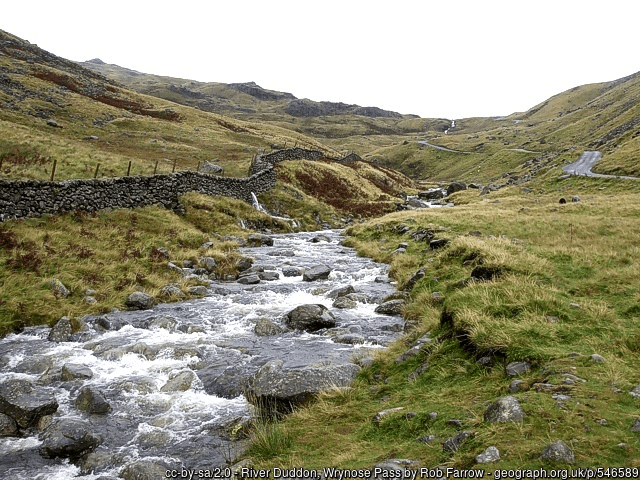
The Duddon’s source is on the wildness of Lakeland’s Wrynose Pass not far from the ruins of a Roman fort, ‘that lone camp on Hardknott’s heights’. The river is set between Eskdale, the mighty peaks of the Scafell range and the Old Man of Coniston.
In this place of ‘sullen moss and craggy mound’ the wild stream cascades over rocks. It seems to seek its own solitude, attended only by its own voice, the music of splashing water, as it thrusts its way downstream.
Wordsworth describes the scene:
A raven croaks on a wind-blown yew and an eagle flies overhead ‘shedding where he flew loose fragments of wild wailing.’ Sheep sleep by the remains of the old Roman fort.
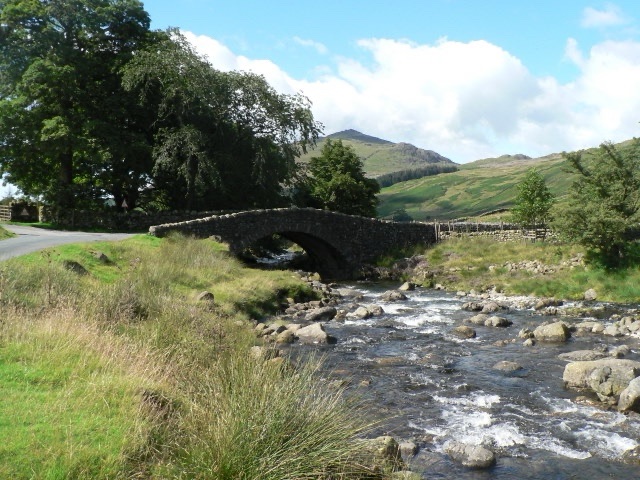
Here the stream is slowing its pace as it passes under this old Lakeland stone bridge. Trees clothe the banks and the riverside vegetation grows more lush with ‘wild strawberries, thyme and ‘trembling eyebright – sapphire blue’. Turn left before the bridge and the road goes to the Roman fort on Hardnott pass.
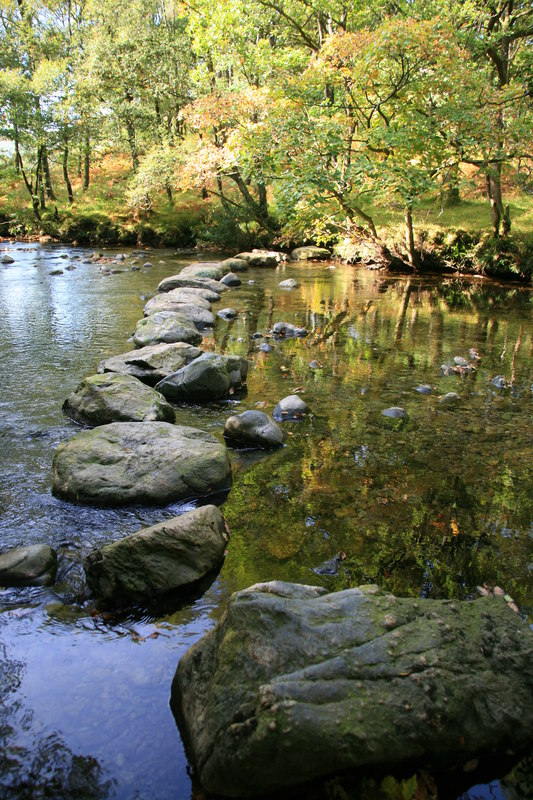
Were these the Duddon stepping stones near Seathwaite mentioned in Sonnet 9?
Here ‘when a flood runs ‘fierce and wild’, the child ‘puts his budding courage to the proof’, whilst ‘declining (and wiser) Manhood learns to note the sly and sure encroachments of infirmity.’!
(Photo by Andy Deacon – geograph)

Poetry of the Heart
Wordsworth pays his tribute to the old vicar Robert Walker who for 60 years faithfully worked here in this humble out-of-the-way place:
….in those days
When this low Pile a Gospel Teacher knew,
Whose good works formed an endless retinue:
A Pastor such as Chaucer’s verse portrays;
Such as the heaven-taught skill of Herbert drew;
And tender Goldsmith crowned with deathless praise!Seathwaite Chapel Sonnet 18
Wordsworth sees beauty and dignity in the poor, the disadvantaged and the forgotten. Those whose lives were lived in obscurity, ignored by the world as insignificant.
- The leech gatherer on the lonely moor.
- The Old Cumberland Beggar.
- The heart- broken shepherd after the death of the last of his flock
- The solitary reaper singing as she worked in the field.
- The despised gypsies’ simple life sleeping out rough under the stars
Wordsworth’s sensitive heart notices the least of things: ‘The meanest flower that grows’, the ruined cottage, the quiet nook, ‘the untrodden ways‘. Even this insignificant river Duddon. That is why so many of us are drawn to Wordsworth and his poetry. Not forgetting the attractive picture we are given of the whole Wordsworth household. Mary his wife and Dorothy his sister, ‘Who gave me eyes to see’ the meanest things.

Still Glides the Stream
Downstream the river becomes shaded by ‘green alders, ashes and ‘birch-trees risen in silver colonnade’. Wordsworth came here fishing as a boy and fell in love with the place. It’s an insignificant river, but for Wordsworth, for whom ‘littleness is not the least of things’ it was special. In 1820 he published his 33 Duddon Sonnets to express his ‘poetry of the heart‘ for this remote place among the ‘untrodden ways’ of Lakeland.
Wordsworth may well have stood on this bridge looking down at the water ‘gliding in silence with unfettered sweep’ towards its final estuary and out into the sea.
Here is his Sonnet 33: a final tribute to this river:
I thought of Thee, my partner and my guide,
As being past away.—Vain sympathies!
For, backward, Duddon! as I cast my eyes,
I see what was, and is, and will abide;
Still glides the Stream, and shall for ever glide;
The Form remains, the Function never dies;
While we, the brave, the mighty, and the wise,
We Men, who in our morn of youth defied
The elements, must vanish;—be it so!
Enough, if something from our hands have power
To live, and act, and serve the future hour;
And if, as toward the silent tomb we go,
Through love, through hope, and faith’s transcendent dower,
We feel that we are greater than we know.
A thought -Wordsworth left us his beautiful poetry and the memory of his humble life. What legacy am I leaving?
 A Listening Heart